
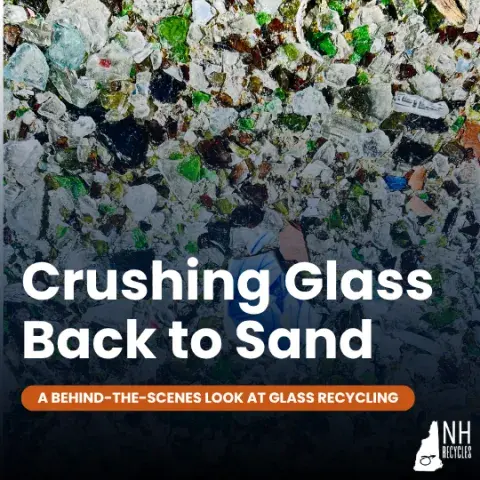
NH Recycles staff recently visited Glass To Sand, LLC (GTS) in Hookset, NH, to see how glass from some of our member communities is processed into a usable construction material. The visit included Executive Director Andrea Folsom, Member Services Director Brian Patnoe, Municipal Recycling Advisor Steve Bean, and Education Coordinator Paige Wilson.
David Martin and Scott Graczyk led the tour and explained how GTS manages different types of glass and prepares finished material for use in various aggregate and construction projects. The process involves separating all paper, metals and plastics that are mixed in with the glass bottles and jars.
Extensive Glass Processing
GTS accepts clean glass bottles and jars, mixed Processed Glass Aggregate (PGA)-style glass, and single-stream glass from a Material Recovery Facility (MRF). Their equipment can also tolerate small amounts of porcelain, ceramics, tile, drinking glasses, and granite countertops, which may end up in a glass pile.
On a typical day, GTS is able to process hundreds of tons each day based on the makeup of the discarded glass.
When single-stream recycling moves through a MRF, materials are sorted by type, size, and shape using equipment and manual labor. Conveyor belts, screens, optical scanners, air jets, magnets, and hand-sorting are used to separate recyclables and remove many large contaminants. However, smaller contaminants may remain in the material stream or fall through the screens. As a reminder, items in your single stream container that are smaller than 2” by 2” are likely to fall through the sorting equipment when it gets to a MRF. They are so small that, instead of being recycled, the pieces end up in piles such as the one pictured to the right.
Glass often breaks during MRF handling and falls through screens, where it can mix with other small materials. As a result, MRF glass may include broken glass pieces along with paper labels and miscellaneous plastics such as bottle caps, buttons, utensils, and straws.

Creating a Multi-Use Product
At GTS, both source-separated glass and MRF glass feedstocks move through a series of crushers, screens, and sorters to create a sand-like aggregate. Glass to Sand has patented the process to create specific aggregates that meet specs for different construction projects.
For more information, please email info@G2S-USA.com.

Glass Recycling Options for NH Recycles Members
NH Recycles members have several practical options for managing glass. Depending on the facility’s space, staffing, collection system, and end-market needs, members can choose from the following programs:
1. Separate clean glass bottles and jars so they can be made into new bottles, other household glassware, or fiberglass insulation.
2. Recycle mixed glass, including bottles, jars, and ceramics, into Processed Glass Aggregate for road or construction projects.
3. Send glass to be crushed back into sand, where it can be used in aggregate and construction projects.
If your community is interested in starting or expanding a glass recycling program, NH Recycles can work with you to evaluate practical next steps. Our Member Services team can discuss what a simple separation program could look like based on your facility’s size, available space, and staff capacity.
To connect with our team, email info@nhrecycles.org.