
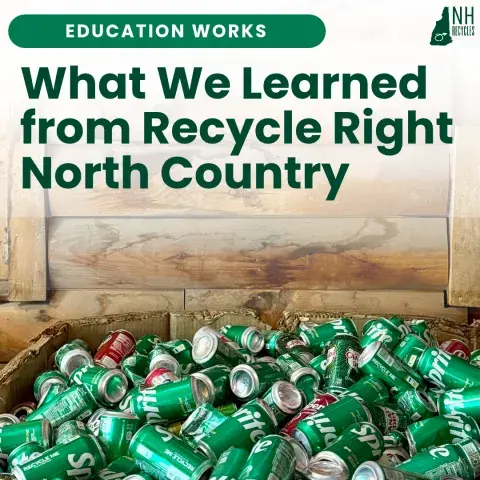
On August 27, NH Recycles returned to the North Country for the final operator roundtable of our Recycle Right North Country project. Held at the Dalton Town Hall, the morning brought together solid waste operators and other recycling partners to look at the final project data, talk honestly about what worked and what didn’t, and discuss what communities can take from the project moving forward.
NH Recycles Executive Director Andrea Folsom, Member Services Director Brian Patnoe, Municipal Recycling Advisor Steve Bean, and Education Coordinator Paige Wilson led the discussion, which was part presentation and part what our roundtables do best: giving operators a chance to ask questions, compare programs, and troubleshoot real-life recycling challenges together.
And after several years of work, we were finally able to answer one of the biggest questions behind the entire project:
Does recycling education actually work?
The short answer is yes.

Three Communities Helped Us Measure the Impact
Recycle Right North Country was funded through a U.S. Environmental Protection Agency Recycling Education and Outreach grant and focused on 30 communities in Coös County and northern Grafton County.
Throughout the project, we shared recycling information in a lot of different ways: direct mail, radio, social media, videos, updated transfer station signs, Recycling 101 presentations, door-to-door outreach, Recycle Right Rewards events, recycling bins, operator training, bus tours, roundtables, and more.
Lancaster, Littleton, and Northumberland served as our three partner communities, allowing us to take a closer look at what happened before and after that focused outreach.
The project began with ambitious goals: increase residential recycling rates by 10%, increase recycling participation by 5%, improve resident confidence in recycling, and reduce recycling contamination by 10%.
We did not hit every target. But the data showed meaningful change — and gave us a much better understanding of where education can have the greatest impact.
Recycling Confidence Increased
Before our Recycling 101 presentations, we heard many of the same questions and concerns that transfer station operators hear every day:
- Is this actually getting recycled?
- Why can I recycle one type of #1 plastic but not another?
- Does what I recycle really make a difference?
- Why does the town next door recycle something my town doesn’t?
Plastics were, by far, one of the biggest sources of confusion.
But after residents received more information about how recycling works, where materials go, why programs differ, and how recycling markets affect what can be accepted, their responses changed.
One resident summed it up especially well:
“I understand the limits of the system, and I still believe recycling is worth doing.”
That is exactly the kind of change we hoped to see. The goal was never to convince residents that recycling is a perfect system. It was to give them enough information to understand the system, trust that their efforts matter, and feel confident recycling correctly in their own community.
Participation Moved in the Right Direction
To measure recycling participation, Brian and Steve spent time at transfer stations counting vehicles, weighing trash and recyclables, and even following curbside collection routes in Lancaster and Northumberland.

That fell short of our 5% project goal, but it still represented measurable improvement.
We also saw a slight combined increase in the amount of recycling generated per resident and, across the three communities, approximately one pound less household trash per resident per week.
As with most solid waste data, the story behind those numbers matters. Programs changed during the project. Facilities accepted different materials. Collection systems differed. Businesses used some facilities more than others. Even the timing of curbside pickup affected what residents brought to the transfer station on the days we collected data.
Those differences reinforced something operators already know well: comparing recycling programs is rarely as simple as comparing two percentages.
Contamination Was a Major Success
One of the clearest results came from recycling contamination.
Contamination was already relatively low when we began collecting baseline data, but after the education and outreach campaign, all three partner communities saw substantial reductions in contamination.
That matters.
For operators, less contamination means less time pulling trash and unacceptable materials out of recycling. Cleaner loads can also mean more marketable material and, when markets are favorable, better revenue.
It also taught us something we did not necessarily expect going into the project:
Reducing contamination may be easier than substantially increasing the recycling rate.
Helping someone who is already recycling put the right material in the recycling container can sometimes be easier than changing the habits of someone who is not recycling at all.
What Worked?
Some of the simplest approaches were also some of the most effective.

Steve also knocked on doors and spoke directly with 175 residents, particularly in multi-unit housing and mobile home communities. Hundreds of recycling bins were distributed in the three partner towns, helping remove another basic barrier: having something convenient to put recyclables in.
At Recycle Right Rewards events, Brian and Steve met residents directly at their transfer stations, answered questions, and handed out local gift cards to people who were “caught” recycling right. When the team returned months later to collect final data, some residents still remembered those conversations — and thanked them for what they had learned.
Over the course of the project, we held dozens of events and reached well over 1,000 participants.
The lesson was not that one particular mailer, sign, presentation, or conversation changed everything.
It was the repetition.
People saw the message at home, at the transfer station, online, at community events, and from the operators they already knew and trusted.
Operators Are Critical Messengers
That brought us to one of our biggest takeaways from the entire project: transfer station operators are some of the most important recycling educators in a community.

During the Dalton discussion, operators talked about everything from confusing plastics and commercial recycling to pay-as-you-throw programs, curbside collection, glass markets, and helping older residents or residents who need additional assistance use their local recycling programs.
Those conversations also reinforced another lesson: there is no single “right” recycling program for every New Hampshire community.
Some communities source separate. Some accept more types of plastic than others. Some collect glass separately. Some offer curbside service. Some use pay-as-you-throw. Each program reflects local markets, infrastructure, staffing, costs, and community needs.
That variation is part of what makes recycling confusing for residents — and why clear, repeated, local education matters.
Not Everything Went According to Plan
A multi-year project also gave us plenty of opportunities to learn what makes this work difficult.
Staff and municipal leadership changed. Recycling programs changed. Contractor cooperation varied. Recycling markets rose and fell. In several communities, it was difficult to engage local decision-makers beyond the operators already doing the work every day.
Those challenges matter because education alone cannot determine recycling outcomes. Program design, convenience, infrastructure, markets, staffing, leadership, and local policy all play a role.
That means long-term recycling projects have to be flexible — because communities and markets will change while the work is underway.
The Biggest Lesson: Keep Talking About Recycling

Education works.
It may not transform a recycling program overnight. It may not immediately produce a 10% increase in recycling. And residents will probably continue asking why their yogurt container has a recycling number on it if their town cannot recycle it.
But good education reduces confusion. It builds confidence. It reduces contamination. And it gives residents a clearer connection between the effort they make at home and what happens to those materials after they leave the transfer station.
Recycle Right North Country may be wrapping up, but that work will continue.
NH Recycles will continue helping our members answer resident questions, improve signage, understand recycling markets, troubleshoot programs, train operators, and share practical solutions from communities across New Hampshire.
Because sometimes improving recycling starts with something as simple as answering the question: “Does this actually get recycled?”
And giving people an answer they can trust.