
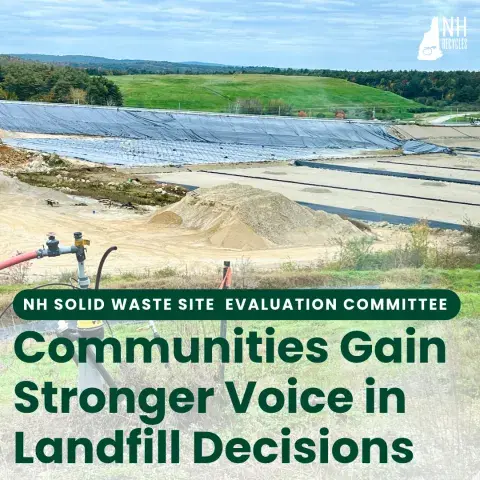
A major change is coming to how New Hampshire reviews new landfill proposals and landfill expansions. At the 2026 New Hampshire Municipal Association conference, NH Recycles’ Education Coordinator Paige Wilson attended a workshop about the new Solid Waste Site Evaluation Committee (SWSEC) presented by Amy Manzelli from BCM Environmental & Land Law and Wayne Morrison from North Country Alliance for Balanced Changed.
In July 2026, Governor Kelly Ayotte signed House Bill 707(opens in a new tab) into law, creating the SWSEC. The committee, established under RSA 149-M:65-86(opens in a new tab), will review proposals for new, large landfills and landfill expansions before they move forward in the permitting process.
Supporters say the new committee fills an important gap in the state's current system and gives communities a stronger voice in decisions that can affect them for generations.
Why Was a New Committee Needed?
For years, New Hampshire's landfill permitting process focused mainly on technical and environmental requirements, such as landfill design, groundwater protection, and leachate management. While these issues remain important, community members often found there was no clear way to address concerns about traffic, noise, odors, property values, recreation, or impacts on local economies and public health.
The push for reform gained momentum during discussions surrounding a proposed landfill project in Dalton. Residents and regional organizations argued that landfill impacts often extend beyond the host community and can affect neighboring towns, waterways, businesses, and recreation areas.
As Manzelli and Morrison explained at the NHMA conference, many of these concerns were outside the authority of existing agencies, leaving residents feeling unheard despite raising legitimate questions about local impacts.
What Is the SWSEC?
The Solid Waste Site Evaluation Committee is a seven-member body made up of representatives from state government, municipal planning, environmental and public health interests, conservation commissions, and the private waste management industry.
The committee was modeled after New Hampshire's long-standing Site Evaluation Committee(opens in a new tab), which reviews major energy projects such as power plants and transmission lines. Its purpose is not to replace the New Hampshire Department of Environmental Services (NHDES), but to add another layer of review focused on broader community and regional impacts. NHDES will continue handling the technical permitting requirements it already oversees.
Looking Beyond the Property Line
One of the biggest changes under the new law is the range of impacts the committee can consider. When reviewing a landfill proposal, the SWSEC may evaluate:
- Human health
- Outdoor recreation
- Wildlife
- Traffic and transportation
- Noise
- Odors
- Local economies
- Scenic resources
- Property values
- Other community and regional impacts
These factors were often difficult to address under the previous permitting framework. The new process allows decisionmakers to take a broader look at how a project may affect people and communities beyond the immediate project site.
Strengthening Local Participation
The law also increases opportunities for public involvement.
Communities, regional planning commissions, and local governments will have a stronger role in providing information and perspectives during the review process. The committee must consider these viewpoints when evaluating whether a project serves the public interest.
Another key feature is the appointment of a "counsel for the public," an attorney from the New Hampshire Attorney General's Office who will represent the broader public interest during reviews. The attorney may hire independent experts to evaluate technical information provided by applicants.
Oversight Continues After Approval
The SWSEC's responsibilities do not end when a project is approved.
The committee has the authority to monitor compliance, investigate violations, impose penalties, and even suspend or revoke certificates if operators fail to meet permit conditions or make misrepresentations during the application process.
Supporters believe this enforcement tool will help ensure that landfill operators remain accountable throughout the life of a facility.
What Happens Next?
Before the new committee can begin reviewing applications, it must develop its own rules and procedures. To allow time for that work, the law includes a moratorium on permits that would create new landfill disposal capacity until the rules are adopted, or until July 1, 2027, whichever occurs later.
While questions remain about how the new process will work in practice, many see the SWSEC as a significant step forward for New Hampshire communities.
By expanding the factors considered in landfill siting decisions and creating a dedicated review process, the state is recognizing that landfill impacts can reach far beyond property boundaries. The new committee aims to balance environmental protection, community concerns, economic interests, and the need for solid waste disposal capacity while giving residents a more meaningful voice in decisions that affect their future.