
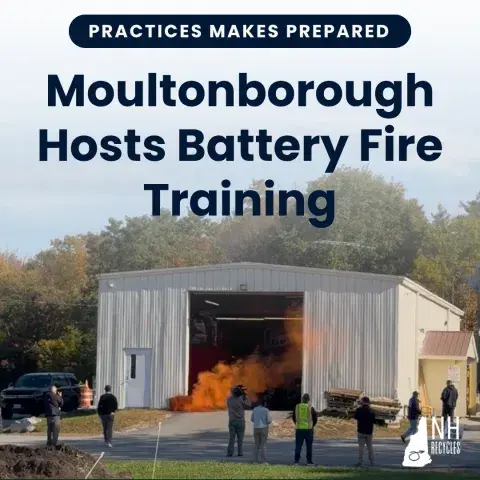
As rechargeable batteries become more common in everyday life, the risk of battery-related fires is increasing at transfer stations, recycling facilities, and in collection vehicles across New Hampshire. To prepare for a potential incident, the Town of Moultonborough put their response skills to the test.
On October 7, transfer station operators, municipal staff, emergency responders, state agencies, and industry partners gathered at the Moultonborough Transfer Station for a day of hands-on training focused on lithium-ion (Li-ion) battery fires.
Li-ion batteries are found in laptops, cell phones, tablets, power tools, e-bikes, vapes, and many other rechargeable devices. When damaged, crushed, punctured, or improperly disposed of, these batteries can enter a process known as thermal runaway, which creates intense heat that can quickly lead to a fire.

Throughout the day, participants worked through three mock emergency drills that replicated situations that may occur at a transfer station. The drill scenarios involved:
- An e-bike battery tossed in the scrap metal pile
- A lithium-ion battery crushed in the trash compactor
- A fire inside the main building caused by a battery in an electronic device

Staff worked through the scenarios as though it was a regular day at the facility, with operators from other towns acting as residents dropping off trash while a fire response was underway. The exercises gave staff the opportunity to practice identifying hazards, communicating with emergency responders, and following proper safety procedures. By creating realistic conditions, the training helped participants build confidence and strengthen their response skills before a real emergency occurs.
The event also highlighted the importance of proper battery recycling. New Hampshire law prohibits the disposal of lithium-ion batteries in household trash, recycling bins, or incinerators. Despite these requirements, rechargeable batteries are still often found in the waste stream, increasing the risk of fires at transfer stations, in garbage trucks, dumpsters and at processing facilities.
Operators can visit our Solid Waste Safety Toolkit(opens in a new tab) for tips on how to prevent battery fires, catch risks early, and protect your staff, facilities and equipment!
NH Recycles Solid Waste Safety Toolkit
Live Burn Demonstration
At the end of the drills, Deputy State Fire Marshal, Tony Booth, and Jerry Sjogren, Senior Director at the Recycled Materials Association, initiated a live burn demonstration of two small Li-ion batteries.
The batteries were placed in metal cages and hooked up to several wires that caused the battery to heat up, in order to trigger a thermal runaway reaction. It took about 2 ½ minutes for the first signs of damage to show up – hissing sounds, increased temperature, and smoke. Just one minute later, the batteries exploded and caught fire, sending pieces of the cage flying across the concrete pad. The demonstration sparked lots of conversations around the importance of safe battery use and recycling.

What Can Residents Do to Help?
Residents play an important role in reducing fire risks and should:
- Never place rechargeable batteries or battery-powered devices in household trash or recycling containers.
- Recycle Li-ion batteries through designated collection programs or municipal transfer stations.
- Check devices such as toothbrushes, toys, tools, and electronics for embedded rechargeable batteries before disposal.
- Contact your local transfer station if you are unsure how to properly manage a damaged or swollen battery.
As battery-powered products continue to grow in popularity, education, proper disposal, and emergency preparedness remain essential to protecting municipal workers, first responders, facilities, and communities across New Hampshire. The Moultonborough mock fire drill demonstrated the value of collaboration and training in preparing for these evolving challenges before an emergency occurs.

THANK YOU to everyone involved who made this training a success - Town of Moultonborough transfer station staff, first responders and municipal officials, the New Hampshire Department of Environmental Services, the New Hampshire Department of Safety's State Fire Marshal's Office, the Recycled Materials Association, Primex, NH Recycles, and all of the solid waste operators who attended.