
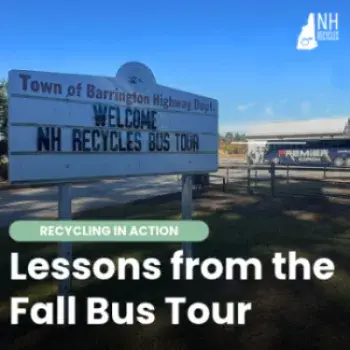
On October 15, over 40 NH Recycles members, board members and municipal recycling professionals traveled around southeastern New Hampshire for our annual Fall Bus Tour. We visited three different facilities that share a common goal: keeping valuable materials out of the waste stream and finding practical solutions for their communities.
The tour offered more than just a look behind the scenes. Each stop provided valuable lessons and ideas that operators can adapt to their own programs, regardless of size or staffing levels.
Town of Candia Recycling Center: Building Trust Through Service and Stewardship
The first stop of the day was the Town of Candia Recycling Center(opens in a new tab), a facility that immediately impressed attendees with its organization, cleanliness, and emphasis on customer service. Chuck Whitcher, Facility Supervisor, led the tour group around the facility and explained some of the facility’s successful features as well as its limitations.
Despite facing storage constraints and operating challenges, Candia has developed a recycling program that delivers both environmental and financial benefits for residents.
One of the most notable aspects of the facility is its philosophy. As Whitcher explained, “If it looks like a dump, people will treat it like a dump.” The center reinforces that philosophy through routine pressure washing, tidy storage areas, and a welcoming atmosphere that emphasizes respect for residents and taxpayers. Staff members know many residents by name and even keep treats on hand for visiting dogs.

Recycling Programs That Generate Results
Candia operates a wide range of recycling programs, including scrap metal recovery, electronics collection, used oil management, plastic bag recycling, and a volunteer-run swap shop. The community has mandatory source separated recycling, and approximately 75% of residents utilize the transfer station.
The facility's non-ferrous metal program stood out as a significant success. By separating and marketing materials such as aluminum and wire, the town has generated substantial revenue. To date in 2026, Candia has earned roughly $65,000 overall from recycling-related programs with about $30,000 from non-ferrous metals alone.

Attendees also learned how equipment investments can improve material value. Candia used machinery to compact 1,400 pounds of shop wire into two gaylord boxes, generating approximately $10,000 in revenue while maximizing container efficiency. Without compacting the wire, each box would have only weighed about 400-600 pounds.
Unique Facts from Candia
- The facility maintains a five-star Google review rating.
- Plastic bags are collected voluntarily, but it can take up to five years to accumulate enough material for a full shipment.
- Last year, the facility produced 281 bales of recyclable material.
- A volunteer-run swap shop operates whenever the transfer station is open.
- The town does not charge residents for used oil, C&D or electronics recycling. Residents receive a substantial tax bill each year that helps cover the costs.
Key Takeaways for Operators
- Customer service matters. Residents are more likely to support recycling programs when facilities are welcoming, organized, and professional.
- Clean facilities encourage better behavior and reduce contamination.
- Even smaller material streams can have value when properly separated and marketed.
- Equipment investments can significantly increase revenue and shipping efficiency.
- Programs should be evaluated not only on profitability but also on the disposal costs they avoid.

Resource Waste Services: Recovering Value from Construction and Demolition Debris (C&D)

The second stop took participants to ReSource Waste Services' (RWS) Epping(opens in a new tab) facility, where attendees got an inside look at one of the region's most advanced construction and demolition (C&D) recycling operations. Guided by David DeVito, VP of Operations, and his team, visitors broke up into smaller groups and witnessed large-scale material recovery driven by heavy equipment, advanced sorting technologies, and a commitment to landfill diversion.
The facility processes about 150,000 tons of material each year, to recover valuable commodities from mixed C&D waste streams including asphalt, brick, concrete, metals, wood and shingles. Any material that cannot be recovered is sent to different locations across New England or shipped by rail to the central and mid-west regions of the U.S, in order to preserve New Hampshire's landfill capacity.
Turning Wood Waste into Valuable Products
One of the highlights of the tour was the facility's wood recovery operation. Massive grapples sort incoming materials and process the wood through a system of screens, eddy currents, optical sorting equipment, and other technologies. The resulting products are marketed into multiple end uses. The facility currently produces three grades of wood:
- Low-grade wood for Alternate Daily Cover (ADC)
- Mid-grade wood for biomass energy generation
- High-grade wood used to manufacture Medium Density Fiberboard (MDF) for furniture production.
RWS is investing in additional optical sorting technology that will reduce lower-value products and significantly increase MDF-grade material production. The change is expected to shift production from 20% MDF today to roughly 50% MDF in the future.
Looking Ahead
The facility is pursuing a permit that would allow RWS to process municipal solid waste on site. The goal is to recover additional recyclables and transport residual materials by rail to preserve New Hampshire disposal capacity.
Visitors learned about ongoing efforts to create new beneficial-use products as well, including research into combining asphalt, brick, concrete, and recycled glass to create pipe bedding materials.
Unique Facts about RWS Epping
- The facility processes about 45 tons of C&D per hour.
- ReSource employs more than 300 people company-wide and processes approximately 650,000 tons of material annually across New Hampshire, Maine, and Massachusetts.
- Roughly 25% of incoming material becomes bypass waste that must be landfilled or shipped elsewhere.
Key Takeaways for Operators
- Municipalities can ship co-mingled C&D to RSW but will get a reduced tipping fee by separating our certain materials, like wood.
- Advanced sorting technologies continue to improve recovery rates and material quality.
- Markets exist for materials many people consider waste, when processing systems are designed to capture value.
- Partnerships between municipalities and processors can improve recycling outcomes while controlling costs.
Barrington Transfer Station & Recycling Center: Balancing Convenience, Cost, and Diversion
The tour concluded at the Barrington Transfer Station & Recycling Center(opens in a new tab), where Erin Paradisy, the Transfer Station Administrator, guided attendees through a facility designed around convenience, transparency, and resident participation. Serving a community of nearly 10,000 residents, Barrington has developed a distinctive approach that blends a Pay-As-You-Throw (PAYT) system with a growing menu of recycling options.

A Longstanding PAYT Program
Barrington implemented PAYT in 1993 and has relied on the model for more than three decades. Revenue from PAYT bags currently covers approximately 70% of disposal and transportation costs, helping the town maintain a financially sustainable system.
The community is also notable for its transparency. The town provides detailed information about fees, program costs, and operational decisions, helping residents understand the economics behind transfer station operations.
Expanding Recycling Opportunities
In addition to single-stream recycling, Barrington offers programs for food waste composting, textiles, books, plastic bags and film, sneakers, electronics, scrap metal, and more. The transfer station collects mobility devices, like canes, crutches, walkers, and wheelchairs, for the Rotary Club of Durham-Great Bay: Mobility for All project. Offering a wide range of programs makes diversion more accessible to their residents.

Barrington transitioned to single-stream recycling in 2013 and began separating glass in 2018. Residents have become accustomed to delivering glass bottles and jars, creating an opportunity for future participation in NH Recycles' clean glass recycling program! The facility continues to evaluate operational improvements, including relocating scrap metal collection for better oversight and palletizing air conditioning units to maximize commodity revenue.

Unique Facts from Barrington
- The town relies on part-time staff and has no full-time transfer station employees.
- The town's first PAYT fee increase did not occur until 2023, thirty years after the program began.
- Barrington developed its own Smart Recycling and Fee Guide(opens in a new tab) to help their residents recycle correctly.
Key Takeaways for Operators
- There is no one-size-fits-all recycling model. Staffing levels, available space, and community needs all influence program design.
- Single-stream recycling can reduce labor requirements and improve convenience for residents.
- Source-separated programs may generate greater value but requires additional space and staffing.
- Transparent communication helps residents understand fees and support operational changes.
- New diversion programs can start small and expand over time as participation grows.
Learning from Different Approaches
One of the strongest themes throughout the day was that successful recycling programs do not all look the same. Candia excels through customer service, source separation, and material marketing. RWS demonstrates the power of advanced processing technologies and end-market development. Barrington highlights how convenience, transparency, and strategic program design can drive participation with limited staffing resources.
For tour participants, the value of the day was not finding a single model to replicate, but discovering ideas that can be adapted to their own communities. Whether it was Candia's commitment to cleanliness, ReSource Waste's focus on recovery and innovation, or Barrington's transparent approach to operations and costs, every stop offered practical lessons that reinforce the important role recycling professionals play in protecting New Hampshire's resources and serving their residents.
