
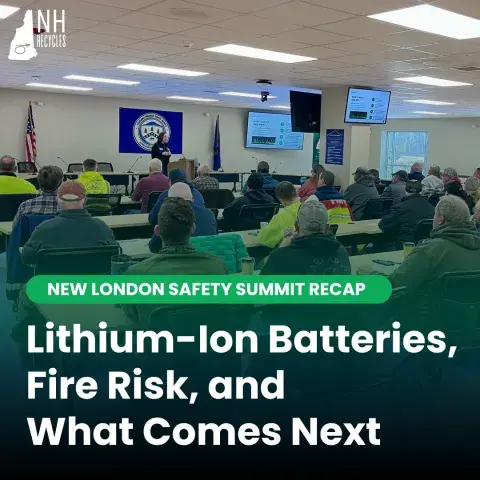
On March 19, 2026, NH Recycles hosted a Solid Waste Safety Summit in New London, bringing together over 70 transfer station operators, municipal staff, fire professionals, and state partners to tackle one of the fastest-growing safety challenges in the waste stream: lithium-ion batteries.
With a full room of “boots-on-the-ground” operators, the conversation focused on real-world risks, practical solutions, and the shared responsibility of keeping facilities—and communities—safe.
Why This Topic Matters Now
Lithium-ion batteries are everywhere—phones, tools, vapes, lawn equipment, and more—and they’re increasingly ending up in the wrong places.
As NH Recycles Executive Director Reagan Bissonnette explained:
“The number one topic that we’re getting so many questions about is rechargeable batteries.”
And the concern is well-founded. Across New Hampshire and nationwide, improperly managed batteries are causing fires in transfer stations, recycling facilities, trucks, and homes.

What Operators Are Seeing on the Ground
Attendees made it clear: this is no longer a hypothetical issue.
As NH Recycles Education & Grants Manager Andrea Folsom noted:
“We are seeing battery fires in homes and at facilities and trash trucks and at recycling centers. This is everyone’s issue now.”
Operator Experience: Fires That Don’t Go Out
One attendee shared a firsthand account:
“We had a battery fire at our transfer station and it took about four hours for it to go out. It just continually burns! Seems like the only way to put them out is bury them in sand [in a bucket].”


Key Safety Takeaways
Across all discussions, several consistent lessons emerged:
1. Batteries Are the Leading Fire Cause
“Lithium-ion batteries are one of the leading causes of fires across the states.” - Tony Booth, NH Deputy Fire Marshal
2. Fires Start Hidden
3. One Battery Is Enough
“It just takes one battery - that can get you.” - Andrea Folsom, NH Recycles
4. Prevention Happens at the Transfer Station
Audience Q&A: Practical Challenges and Solutions
One of the most valuable parts of the Safety Summit was the open discussion with operators.
Should We Just Collect All Batteries Together?

“Why not just say all batteries come here and take all the guesswork out of it for residents?”
Response:
Collecting all batteries in one place is often the safest approach, especially given how difficult it can be to distinguish battery types, but we also acknowledge the real-world constraints facilities face. Space, staffing, and site layout can limit what’s feasible, so while a centralized system is ideal, operators are encouraged to implement practical solutions that fit their operation while still reducing risk. As Andrea noted during the discussion:
“We know the realities of facilities, the space you have, the time you have, the manpower you have—it’s not always something that we can all do, so you just do your best.”
Hidden Batteries Are a Growing Problem
Operators highlighted the growing challenge of batteries embedded in everyday devices, noting that items like small electronics and especially vapes are increasingly difficult to identify and manage. Because these batteries are often hidden inside products that appear to be metal or general waste, they frequently slip into scrap metal or trash undetected, increasing the risk of fires. As NH Recycles Municipal Recycling Advisor Steve Bean noted during the Summit, "if an item has a cord, if it’s got any rechargeable function, you need to take a look at that,” underscoring how easy it is for these materials to be overlooked without careful inspection.
Extended Producer Responsibility (EPR): A Potential Game-Changer
A major question from the audience:
“Does any of this ever go back to the manufacturer?”
What is EPR?
NH Department of Environmental Services Waste Reduction and Diversion Planner Paige Wilson explained:
“Extended producer responsibility is exactly what it sounds like. It extends the cost of managing items back onto the producer.”
What’s Proposed in New Hampshire?

“The costs wouldn’t fall onto you guys as municipalities. They would go back onto the battery manufacturers.” -Paige Wilson, NHDES
What This Means for Communities
Final Takeaway
If there was one message that came through loud and clear:
This is preventable—but only if everyone plays a role.
From operators catching a battery before it’s compacted, to residents making better disposal decisions, to policy changes that support safer systems—every piece matters.
Or, as one attendee put it best:
“All batteries in one spot is better than a fire!”
