
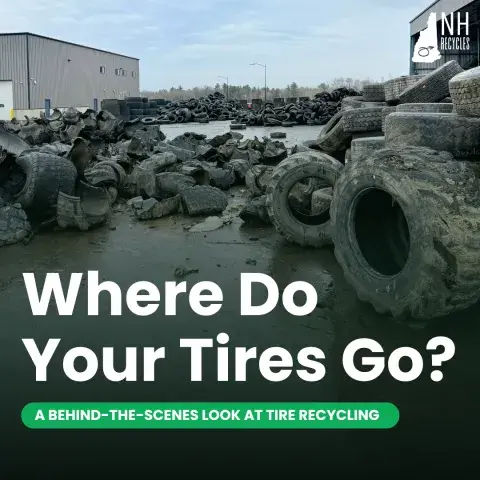
Recently, the NH Recycles Member Services team—including Member Services Director Brian Patnoe, Municipal Recycling Advisor Steve Bean, Executive Director Reagan Bissonnette, and Education & Grants Manager Andrea Folsom—had the opportunity to tour BDS Tire Recycling in Fairfield, Maine. Hosted by Scott Matteson, the visit offered a firsthand look at what really happens to tires after they leave your transfer station!
Here’s the bottom line: tires don’t just get shredded and burned. They’re turned into new, useful materials that show up in more places than you might expect.
From Tires to New Products

At BDS Tire Recycling, old tires are carefully processed into several valuable materials:
Crumb rubber used in football and turf fields across New England and beyond (pictured to the left)
Rubber mats, often found in gyms, barns, and industrial settings
Backing for hardwood flooring, produced in Ontario
Backing for ceiling tiles
Fuel for paper mills, where it helps generate steam and even keeps equipment clean
BDS is currently the only facility in New England producing crumb rubber, making it a critical regional partner in keeping tires out of disposal.
What’s Inside a Tire?


Closeup inside of truck and car tires - nylon, metal, and rubber
Understanding how tires are recycled starts with what they’re made of:
- Car tires:
- 16% wire
- 3% nylon
- 81% rubber
- Truck tires (preferred for certain products):
- 22% wire
- <1% nylon
- ~78% rubber
Truck tires are especially valuable because they are fully black—an important requirement for products like crumb rubber and rubber mats.
Nearly Nothing Goes to Waste
One of the most striking takeaways from the tour: BDS uses 97% of every tire it receives.
- Rubber becomes products or fuel
- Steel wire is separated, compacted with a hydraulic press, and recycled daily
- Nylon (about 3%) is currently the only material without a strong market and is sent to Canada for incineration
That level of recovery is a strong example of what effective recycling systems can look like.


(Left) metal being processed out of the tires (Right) a shovelful of nylon after separation
A Key Role in Regional Energy
Recycled tires also play an important role in energy production. During peak season (January through March), paper mills rely heavily on tire-derived fuel:
- 700–800 tons of tire material are used to generate steam
- The rubber is added to wood chips in boilers
- It helps keep boiler screens clean, improving efficiency
How Tire Collection Works
BDS operates on routes with packer trucks that can hold up to 1,200 tires at a time, which means it's important NH Recycles Member's call when they have gathered 100 tires (waiting until you have more tires WILL NOT save you money and may even mean that all your tires won't be picked up at once!) Once tires are collected, they are brought to the BDS facility in Maine where they go through several shredding and screening processes, depending on what they will ultimately become.


(Left) a truck being unloaded - tires fall down onto a walking floor, where they begin their processing journey (Right) inside the processing plant, tires are screened to specifications dependent on the end market, going through a variety of shake-tables and screens to remove any contamination.


(Left) rubber chips being kept dry prior to additional processing (Right) bag of fully processed rubber sitting on a scale
Why Preparation Matters
The tour also highlighted a challenge many facilities may not see: tires with rims still attached.
At BDS, staff must manually remove each rim—a time-intensive process, especially when handling millions of tires annually. Smaller tires with rims (under 15 inches) are particularly difficult, as machinery must cut and peel the tire to remove the metal.
What this means for operators:
- Remove rims before shipping whenever possible
- Separate smaller tires carefully
- Proper prep makes a real difference in safety, efficiency, and cost
NH Recycles Impact
In 2025 alone, New Hampshire Recycles helped move:
- 30,840 tires
- 274 tons of bulk tires
- Across 57 member communities
That’s a significant amount of material kept in circulation—and out of disposal.
The Big Picture
Tire recycling is happening—and it’s happening close to home. Tires are being turned into fields, flooring, mats, and energy, with 97% of each tire put to use.
That’s the kind of practical, real-world solution NH Recycles is built around.
Have Tires Ready to Go?
If you have questions about tire recycling or are ready to schedule a pickup:
- Reach out to the NH Recycles Member Services team
- Or email info@nhrecycles.org
We’re here to help make the process straightforward—and make sure those tires keep working long after they leave your site.

(From Left) General Manager of BDS - Scott Matteson; NH Recycles Staff - Reagan Bissonnette, Andrea Folsom, Steve Bean, and Brian Patnoe