
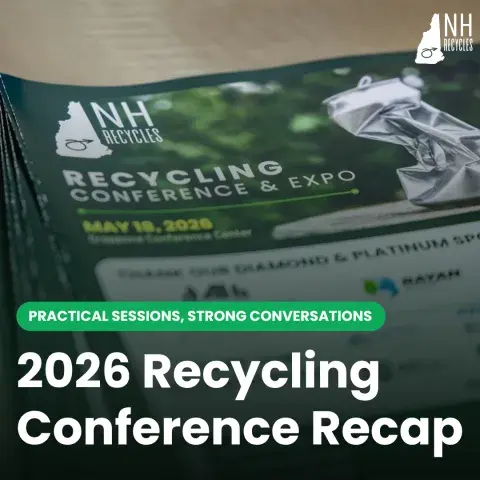
NH Recycles welcomed nearly 300 attendees to the 2026 Recycling Conference & Expo on Monday, May 18, at the Grappone Conference Center in Concord — our largest one-day conference attendance in the past decade.
This year was also our first time trying a one-day conference format, and we are happy to say it was a success.
The day was full, focused, and practical. It brought together the people who operate, manage, and support recycling and transfer stations in New Hampshire, Vermont, Massachusetts, and Maine. Transfer station operators, municipal staff, state and local officials, recycling and waste management companies, community partners, exhibitors, speakers, and interested residents all came together for a full day of workshops, conversations, and shared problem-solving.
At NH Recycles, we know recycling and solid waste programs work best when people have access to clear information, strong peer connections, and practical tools they can bring back to their communities. That was the goal of this year’s conference — and based on the energy in the rooms, the conversations in the hallways, and the feedback we received afterward, it was clear this kind of gathering continues to matter.

A One-Day Format with a Lot Packed In
Moving to a one-day conference was a big change, and we were not sure exactly how it would feel. Would people still have enough time to connect? Would the schedule feel too packed? Would attendees be able to get the practical information they came for?
The answer, overall, was yes!

One attendee described the workshops as “learning material we can actually bring back to the facility.” Another said the sessions were “full of information I didn’t have but need.” Others pointed to “practical knowledge,” “relevant topics with good quality discussion,” and “useful information that I could apply to day-to-day operations and long-term goals.”
That is exactly what this conference is designed to do!
Built Around Real-World Recycling Challenges
The 2026 program focused on the day-to-day realities facing municipal recycling and solid waste programs, including safety, compliance, markets, budgeting, policy changes, food waste diversion, product stewardship, and material-specific challenges.
This year’s conference included two optional workshop tracks to help attendees plan their day:
The Operators Track focused on boots-on-the-ground topics such as battery safety, vapes, mattress recycling, e-waste, single stream processing, unusual materials, plastics markets, financial realities, and reuse.
The Managers Track took a broader look at program oversight and planning, including budgeting, grant writing, food waste ban compliance, product stewardship policy, municipal composting, circular economy tools, and current waste-related legislation in New Hampshire.

While the tracks helped attendees navigate the program, all sessions were open to everyone. That mix was intentional. Strong recycling programs depend on operators and managers understanding each other’s challenges, and this year’s conference created space for both practical facility-level conversations and bigger-picture planning.
Practical Sessions, Strong Conversations, and Shared Learning
The day opened with workshops on some of the most pressing issues facing local programs right now, including lithium-ion batteries and vapes, mattress recycling, decentralized composting, plastics markets, and difficult public interactions at transfer stations.
From there, attendees moved through sessions covering e-waste processing, unusual materials and incidents, grant writing, New Hampshire’s food waste disposal ban, and emerging product stewardship policy.

Some of the strongest attendee interest centered on practical, operator-facing sessions, including batteries and vapes, unusual materials and incidents, e-waste, battery safety, mattress recycling, and handling difficult public interactions. That feedback reinforced what we hear often from members: people want information that is clear, useful, and connected to the work they are actually doing at their facilities.
Battery safety was one of the most talked-about topics of the day. Attendees shared that they plan to bring back updated information about lithium batteries, review battery storage practices, pass along NHDES battery disposal handouts, and make safety improvements at their facilities.
One attendee wrote, “We need to make a few tweaks to our battery recycling program for safety and recovery.” Another said they planned to take back “ideas on how to better store/recycle batteries.” Several others mentioned updating webpages, sharing battery and vape information with residents, and reviewing proper handling procedures with staff.

The “Learning through Experience: A Lesson in Weird Things & Incidents” workshop also stood out. Attendees appreciated hearing directly from others about unusual situations, safety concerns, and lessons learned at transfer stations.
One person shared that the session offered “great information to use on the boots on the ground perspective.” Another said it was valuable to hear about “actual strange events at transfer stations and how they dealt with it.” One attendee left with a very specific action item: “Put a list of emergency numbers up on the wall in the transfer station shed.”
That kind of takeaway matters. It is practical, immediate, and directly connected to safer operations.
The Exhibit Hall and Networking Still Matter
A major part of the conference happens outside the workshop rooms.
Throughout the day, attendees spent time in the exhibit hall talking with vendors, service providers, sponsors, speakers, NH Recycles staff, and one another. These conversations are a big part of what makes the conference valuable. Sometimes the most useful information comes from a formal presentation. Sometimes it comes from finding another operator who has already dealt with the same problem you are trying to solve.
Attendee feedback once again highlighted networking as one of the most valuable parts of the event. 
“More contacts means more collaboration,” one attendee wrote. “Always a huge value to move our recycling mission forward.”
Another shared, “I think making connections with people was probably the most valuable aspect. I hope to maintain those connections long after the conference.”
Those connections are especially important in solid waste and recycling, where communities are often facing similar challenges but may not have regular opportunities to compare notes, ask questions, or hear how others are handling the same issues.
One attendee summed up an important part of the day this way: “DES and NH Recycles and others are here to help. When you have a question, ask. Others may have experienced similar problems or have the same questions.”
That spirit of shared learning is at the heart of the conference.
A Moment of Thanks

During lunch, Andrea took a few moments to recognize outgoing Executive Director Reagan Bissonnette for her years of leadership, steady guidance, and deep commitment to strengthening recycling across New Hampshire. As part of that thank-you, NH Recycles presented Reagan with a handblown Simon Pearce glass tree made from 100% recycled glass.
The tree was made in Vermont (not New Hampshire, as Andrea accidentally said during her remarks) but the sentiment was exactly right: a recycled glass gift to honor years of leadership in recycling.
It was a fitting moment in a day focused on connection, practical problem-solving, and the people who keep recycling moving forward in New England. NH Recycles is grateful for Reagan’s leadership and excited to continue building on that strong foundation.
Ideas Attendees Are Bringing Home
The conference may only last one day, but the impact continues when attendees bring new ideas home and put them into practice.
Survey responses showed that attendees left with concrete next steps for their facilities, towns, organizations, and communities, including:
- reviewing and updating operating plans;
- improving battery handling and storage;
- sharing lithium battery and vape information with residents;
- improving emergency preparedness and first aid planning;
- exploring composting opportunities;
- strengthening single stream recycling practices;
- updating facility signage and public education materials;
- pursuing grant opportunities;
- connecting with vendors and other towns; and
- bringing new information back to staff, boards, committees, and residents.

One attendee said they planned to “check our operating plan again this year to make sure it is all up to date.” Another planned to bring back “information to pass along to other employees and residents.” Others mentioned sharing budgeting materials, discussing composting with local committees, and using new vendor contacts to explore options for hard-to-manage materials.
That is the kind of follow-through that strengthens recycling programs across New Hampshire.
Thank You to Our Speakers, Sponsors, Exhibitors, and Attendees
A conference like this works because people show up ready to share what they know.

Most importantly, thank you to everyone who attended.
Whether you operate a transfer station, manage a municipal program, serve on a town committee, support recycling through your business, work in state or local government, or simply care about strengthening recycling in your state, your participation helped make the day a success.
Why This Gathering Matters
Recycling and solid waste work can be complicated, local, and constantly changing. Markets shift. Regulations change. New materials show up at the facility. Residents have questions. Budgets are tight. Safety concerns are real.
No one should have to figure all of that out alone.

The survey results were clear: attendees want more practical training on facility operations and safety, hard-to-recycle materials, resident education and outreach, recycling markets, scrap metal, lithium-ion batteries, propane tanks, household hazardous waste, composting, electronics, glass, plastics, legislation, and more.
We heard you.
NH Recycles will continue building workshops, resources, and technical assistance around the real questions and challenges facing New Hampshire communities.
Thank you for making our first one-day Recycling Conference & Expo such a strong success — and for making it our largest one-day conference in the past decade.
We look forward to continuing the conversations, connections, and practical problem-solving in the year ahead.


