
A recent press release(opens in a new tab) from the New Hampshire Department of Environmental Services (NHDES) shared a new, statewide study that provides the most comprehensive picture to date of food loss and waste in New Hampshire. The study identified significant opportunities to reduce disposal, strengthen food recovery efforts and support implementation of the state's food waste disposal ban.
The New Hampshire Food Waste Generation Study and Infrastructure Analysis(opens in a new tab) examined food waste generation across 17 sectors, evaluated existing diversion and processing infrastructure, assessed potential climate benefits and shared recommendations to improve compliance with New Hampshire's food waste disposal ban, which took effect on Feb. 1, 2025.
Read the Full New Hampshire Food Waste Study(opens in a new tab)
Food Waste Remains a Significant Portion of New Hampshire's Waste Stream
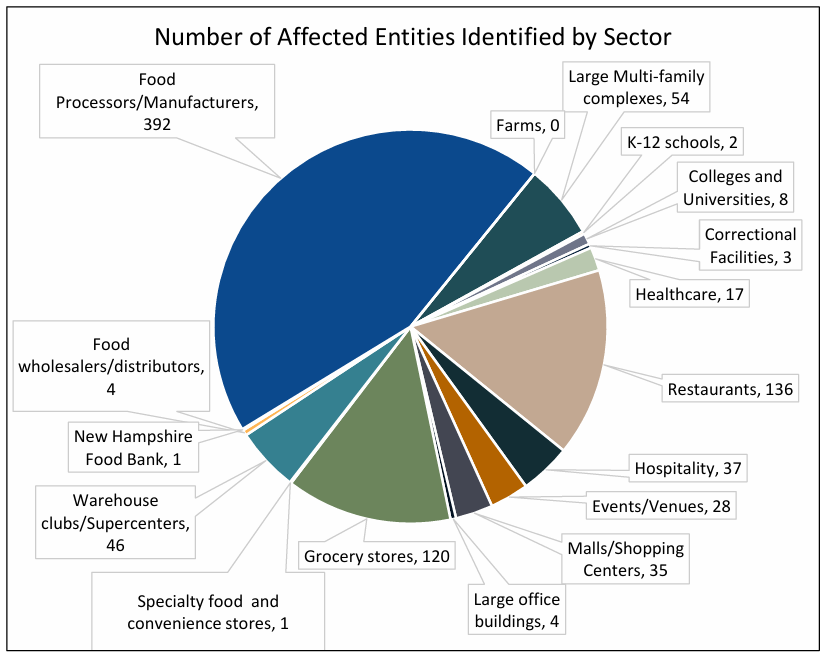
The study builds on findings from New Hampshire's 2024 Waste Characterization Study(opens in a new tab), which identified food waste as the largest component of the state's disposed municipal solid waste stream. This study identified 888 large food waste generators, known as affected entities (AEs), that collectively generate an estimated 222,220 tons of food loss and waste annually. About 67,338 tons are still being disposed, while the remainder is already being donated, fed to animals, composted or otherwise diverted.
The largest generators are:
- Food processors and manufacturers: 155,570 tons
- Grocery stores: 32,294 tons
- Restaurants: 10,860 tons
- Hospitality businesses: 5,198 tons
The study found that food manufacturers and processors already divert much of their material through animal feed, donation and composting programs, while grocery stores and restaurants present some of the greatest opportunities for additional diversion.
Infrastructure Gaps Present a Major Challenge
While the study found strong interest among businesses and institutions to comply with the food waste disposal ban, infrastructure limitations remain a significant barrier.
Researchers identified:
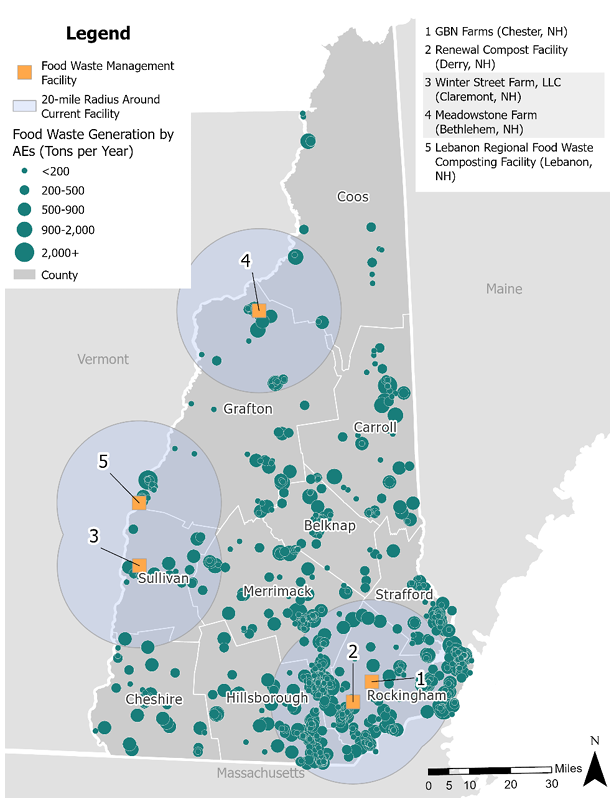
- 19 composting facilities within New Hampshire and 20 miles of the border.
- 2 anaerobic digestion facilities near the state border.
- 11 organics haulers.
- 1 food bank and 379 food pantries.
Despite these resources, available capacity falls short of current needs. The study estimates New Hampshire's in-state processing infrastructure provides approximately 8,096 tons of annual capacity, leaving a capacity gap of more than 28,000 tons per year for food waste generated by affected entities located within compliance areas.
The report also found that composting facilities and hauling services are concentrated in southern New Hampshire, while central, northern and rural regions have limited access to processing and transportation options.
Key Findings
Several themes emerged throughout the study:
- Businesses generally want to comply with the food waste disposal ban.
- Infrastructure and transportation limitations are larger obstacles than lack of motivation.
- Overproduction and plate waste are among the most common causes of food waste.
- Food donation and source reduction offer the greatest climate benefits but can be operationally challenging.
- Animal feed diversion is widely used throughout the state but is not consistently tracked.
- Improved data collection is needed to measure progress and guide future investments.
What This Means for NH Recycles Members
Municipal transfer stations do not have to accept food waste from businesses affected by the state's disposal ban. However, the report reinforces several priorities already familiar to municipalities, transfer stations, operators and recycling advocates.
1. Expand Community Composting and Organics Infrastructure
Many regions of New Hampshire lack convenient composting options. The study identifies substantial opportunities for:
- New composting facilities.
- Expansion of existing facilities.
- Hub-and-spoke collection systems.
- Municipal food scrap diversion programs.
- Organics hauling.
2. Strengthen Education and Outreach
Both generators and processors cited contamination and lack of awareness as major barriers. Clear signage, staff training and public education will be critical as participation grows.
This aligns closely with NH Recycles' existing education efforts, composting resources and food waste diversion tools.
3. Support Food Donation Before Composting
The study strongly encourages organizations to follow the EPA's Wasted Food Scale(opens in a new tab) by prioritizing:
- Source reduction.
- Food rescue.
- Food donation.
Composting remains important but should generally come after efforts to prevent waste and feed people.
4. Improve Organics Collection and Hauling
Transportation was consistently identified as the largest barrier to diversion. Expanding organics hauling networks and aggregation points will be necessary to improve access across the state.
5. Build on Existing Successes
The study specifically highlights NH Recycles' contributions, including:
- The Composting and Food Waste Diversion Map(opens in a new tab).
- A Composting Toolkit(opens in a new tab) for operators.
- Municipal program guidance.
- Partnerships with the New Hampshire Food Alliance, UNH Extension and other stakeholders.
The Bottom Line
For NH Recycles members, the message is clear: reducing food waste offers one of New Hampshire's biggest opportunities to conserve resources, reduce disposal costs, support local food systems and meet state waste reduction goals. Success will depend on expanding diversion infrastructure, improving education and ensuring that edible food reaches people before it ever becomes waste.
Read the Full New Hampshire Food Waste Study(opens in a new tab)