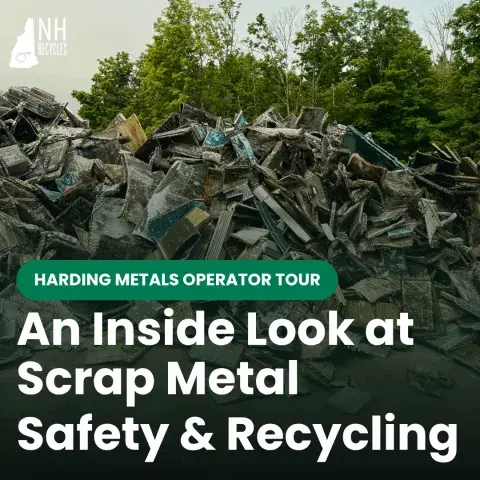
Harding Metals Tour Gives Operators an Inside Look at Scrap Metal Safety and Recycling
August 25, 2026
On a beautiful — and very warm — July day, solid waste operators from across New Hampshire gathered at Harding Metals for a behind-the-scenes look at how scrap metal is processed and why careful separation of contaminants is so important for both safety and recycling.
The tour was offered by NH Recycles as part of its USDA Solid Waste Management Grant focused on improving solid waste safety. Operators attended from communities and facilities including Rollinsford, Wilton, BCEP, Jaffrey, Sanbornton, Hancock, and Warner.
The group was welcomed by Eds Harding, a third-generation member of the Harding family. Harding Metals has been in business since 1963 and today serves as a consolidation point for scrap metal from a wide variety of sources.
Eds explained that approximately 60% of the material processed at the facility comes from industrial sources, 30% from commercial customers — including municipalities — and 10% from retail customers.
Once material arrives at Harding Metals, it is sorted and processed before being shipped to end markets both within and outside the United States. The facility sends out approximately 12 full tractor-trailers of scrap metal each day, with material ultimately moving to smelters in locations including Pittsburgh, Kentucky, and Chicago.
Seeing Scrap Metal Processing Up Close
Throughout the tour, operators saw firsthand just how many different forms scrap metal can take.
Harding Metals receives everything from flatbeds and large dump bodies to loose metal turnings created during manufacturing. Those turnings may contain oil or coolant that must be separated from the metal before it can be recycled. The facility uses equipment to spin metal shavings out of coolant, while oil from turnings is removed and sent to Safety-Kleen for proper handling.
The tour reinforced an important lesson for transfer station operators: just because something is made of metal does not necessarily mean it belongs in the scrap metal pile.
For example, Eds noted that ammunition shells cannot be included with scrap metal. Other materials may contain hidden fuel sources, batteries, or other contaminants that create serious safety concerns if they make it into the recycling stream.
Municipal aluminum cans are one material Harding Metals is happy to receive. The facility accepts bales of aluminum cans from municipalities, then breaks them apart and reprocesses the cans into larger, denser bales that are more efficient to ship. A single bale can contain approximately 30,000 aluminum cans.
Operators also got a memorable demonstration of the facility's truck scale when the entire group climbed onto it together. Combined, the group weighed in at just over one ton. They also got to push the button on the car crushing machine, watching car after car being flattened.
Scrap Metal Safety Starts Before the Material Arrives
Safety is a major focus at Harding Metals. Employees meet every Monday to discuss safety and environmental issues and review current practices.
During the tour, Kevin from Harding Metals shared fire prevention guidance from REMA centered around four key areas: prevention, detection, mitigation, and education.
Much of that work begins with good housekeeping and well-established procedures at the transfer station.
Operators were encouraged to keep their facilities in good working order, clearly communicate what materials are and are not accepted, maintain an up-to-date fire response plan, and have appropriate fire prevention and response equipment readily available.
Just as importantly, employees need to know what hazards to look for as materials arrive.
A barbecue grill, for example, may appear to be an ordinary piece of scrap metal but could still contain a battery used for an electronic starter. Even a standard AA battery can create a spark capable of igniting surrounding material. Lithium-ion batteries present an even greater concern when they are hidden inside equipment.
Other items requiring careful inspection include snowblowers and lawnmowers, which may still contain gasoline or, in the case of electric equipment, lithium-ion batteries.
One of the more surprising hazards discussed during the tour was old stage lighting. Certain lenses can magnify sunlight enough to ignite nearby combustible material.
These examples highlighted the importance of having a consistent process for inspecting and accepting scrap metal before it reaches the pile.
Kevin also encouraged operators to invite their local fire departments to visit their transfer stations. Walking through the facility together gives firefighters an opportunity to understand the site layout, identify potential hazards, and discuss how an emergency would be handled before one occurs.
Operators Take Lessons Back to Their Communities
Feedback following the tour showed that participants found the experience valuable.
All operators who completed the post-event survey said they learned something new about safe and effective recycling, material management, or waste diversion. When asked what was most helpful, operators repeatedly pointed to the opportunity to see the recycling process firsthand.
Responses included:
“Different separation of metals.”
“The emphasis on removing flame source and fuel from recycling stream.”
“Learning better ways to handle different materials.”
“Being able to come here and see how it works on this end.”
“Wire and aluminum separation.”
“Seeing the vendors process.”
“Touring a facility that processes metals and their routine watching for dangerous products and safety of people.”
One participant also noted a practical takeaway they had not known before the tour: the metal ends of electrical cords can be recycled.
For transfer station operators, seeing what happens to materials after they leave their facilities helps connect everyday sorting decisions with what happens farther down the recycling chain. It also demonstrates why keeping batteries, fuel, ammunition, and other contaminants out of scrap metal is more than a matter of producing a clean commodity — it is an important part of protecting workers, facilities, equipment, and communities from preventable fires and other hazards.
The Harding Metals tour gave operators the opportunity to ask questions, see the material processing system in action, and return to their own facilities with practical ideas for making scrap metal recycling both safer and more effective.
Required disclaimer: This material is based upon work supported under a grant by the Rural Utilities Service, United States Department of Agriculture. Any opinions, findings, and conclusions or recommendations expressed in this material are solely the responsibility of the authors and do not necessarily represent the official views of the Rural Utilities Service.