
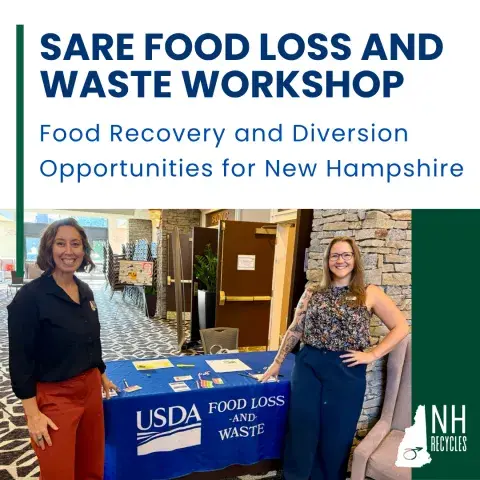
Executive Director Andrea Folsom and Education Coordinator Paige Wilson recently attended a day-long Sustainable Agriculture Research and Education (SARE) workshop focused on reducing food waste in New Hampshire. The workshop brought together a small group of about 20 stakeholders working across food access, municipal solid waste, policy, agriculture, public health, and community education.
Participants included Kathryn Downey from NH Hunger Solutions; Jenny Mitchell and Mike Nork from the New Hampshire Department of Environmental Services; Erica Douglas from the Town of Bedford; Scott Perkins and Jeff Lafleur from the City of Nashua; Hudson Wells from the NH Food Bank Fresh Rescue Program; Allison Bussiere from Gather; Rusty Daniels from Center for EcoTechnology; representatives from UNH Cooperative Extension, the New Hampshire Department of Agriculture and Department of Health and Human Services; local organic farmers and other stakeholders. The morning featured presentations, followed by a guided discussion in the afternoon.
Presentations shared useful context about the connections between food waste, food insecurity, and local diversion efforts through recovery and composting. One notable point discussed during the workshop was that many households receiving SNAP benefits are working households, older adults, people with disabilities, and children. That reminder underscored the importance of approaching food recovery and food waste reduction as both an environmental and community support strategy.

(Above) An overview of New Hampshire populations that rely on SNAP benefits.
Erica Douglas, Environmental Coordinator for the Town of Bedford, presented about Bedford’s composting program. She highlighted that the town has reduced its waste stream through several food waste reduction and diversion efforts. Bedford’s approach includes home composting education, on-site composting of select food scraps, and residential collection through Renewal Composting. The data she shared clearly showed how local programs can make measurable progress when residents have practical options and consistent information.

(Left) Erica Douglas shares the positive results of Bedford's food scrap diversion efforts. (Center & Right) Signs created by students for Bedford's food scrap program.
The workshop also highlighted a recurring challenge for municipalities and organizations: limited funding. While much of the discussion focused on what communities can do with little or no funding, continued reductions at the federal and local levels affect both nonprofit organizations and municipalities. These reductions can limit grant awards, staff capacity, outreach, and the ability of towns to launch or expand food waste diversion programs.
Following the workshop, NH Recycles has several opportunities to support municipal members. We can share more information about services such as the NH Food Bank and Fresh Rescue, which help communities reduce food loss by directing edible food to people rather than disposal. We also plan to highlight Bedford’s work as a success story in our next grant project and may explore opportunities to support Nashua with resident education around composting and food waste diversion.
Another topic worth watching is the possibility of a future composting program in New Hampshire connected to Waste Management (WM). This was mentioned during the discussion, but participants did not have many details, so additional follow-up is needed.
One of the most important takeaways came near the end of the day, when Jeff from Nashua noted that many of the “on-the-ground” operators—the people doing the daily work of managing waste, composting, collection, and outreach—were not in the room. His comment was a powerful reminder of why NH Recycles’ work matters. Bringing practical waste diversion information directly to operators, municipalities, and community partners helps close that gap and ensures the people carrying out this work have access to the resources, connections, and examples they need.