
This case study reviews safety and groundwater contamination concerns at the Town of Andover transfer station, with a primary focus on scrap metal contamination and household hazardous waste (HHW) disposal. The project was completed in July 2026 with guidance from NH Recycles, as part of a USDA grant.

Main NH Recycles Recommendations:
- Improve resident education
- Inspect incoming and outgoing loads
- Increase signage in key areas
- Continue operator training
- Promote HHW event participation
- Consider two-stage scrap metal separation where space allows
INTRODUCTION
During July 2026, the Town of Andover, NH, with the guidance of NH Recycles as part of a USDA grant conducted a case study in regard to safety and ground water contamination. The majority of this was looking at scrap metal but also included other recyclables as well.
RESIDENTIAL EDUCATION
At the beginning of the project, NH Recycles mailed all addresses in the town postcard with the following information:
- HHW disposal options including a QR code for local collection events
- Battery safety issues with a QR code for information specific to vapes

The postcard created by NH Recycles for Andover residents to educate them about battery safety issues and Household Hazardous Waste (HHW) disposal options.
NH Recycles Recommendations:
Residential education is a key aspect to help reduce contamination and safety concerns. While we understand that not all towns can do a direct mailer to all households in the town, there are other ways to educate residents inducing:
- Signage at the transfer station (including scrap metal guidance and disposal bans). Signs can be downloaded and printed from the NH Recycles Sign Library(opens in a new tab) or ordered through NH the Beautiful Sign Program(opens in a new tab) using your annual, municipal points.
- Share articles on social media and town website, including NH Recycles news articles(opens in a new tab).
- Post links on town website to important sites like HHW events, NHDES Managing My Waste webpage(opens in a new tab), and the NH Recycles Resource Library(opens in a new tab).
- Place handouts at the transfer station, town office and other public spaces.
- Create a FAQ page on your town website and create a QR code which you can print and hand out at the transfer station.
- Use a TV screen to create a revolving bulletin board with notices for your residents.

OPERATOR TRAINING
The solid waste industry is constantly changing and NH Recycles understands this, so they offer several training opportunities for members each year. This can range from bus tours, conferences, member-only meetings, webinars, and in-person summits or site visits. During this grant period, operators from Andover attended the following NH Recycles training/meetings:
- 2026 NH Recycles Conference – 5 operators
- Solid waste safety site visit – 3 operators
- Solid waste safety tour – 1 operator
In total, staff attended 41 hours of training regarding operations and safety for transfer stations.
NH Recycles Recommendations:
- Keep eye on upcoming events through NH Recycles, NHDES, and your local planning commission(opens in a new tab). For the Town of Andover, that is the Lakes Region Planning Commission(opens in a new tab).
- Sign up for NH Recycles Full of Scrap Newsletter(opens in a new tab).
If you have questions, don’t be afraid to contact Member Services at NH Recycles via email (info@nhrecycles.org(opens in a new tab)) or by phone (603) 736-4401. You are not alone in this. We are here to help and can point you in the right direction.
SCRAP METAL CONTAMINATION
Accepting scrap metal at a transfer station is a convenience and a proper disposal option for residents as well as a revenue source for towns. As times change, so do regulations, concerns, and safety issues.
Most scrap metal that NH Recycles members collects is either baled, shredded, or a combination of both after it leaves their facilities. Baling helps reduce air space so vendors can transport more material to a shredder. Shredders condense material and remove most of the contamination like cloth, plastic, and other materials. In doing so, this creates areas of concern for both groundwater contamination and fire hazards. Those hazards include gas, oil, batteries, explosive gases like propane, and other materials.
The Town of Andover transfer station itself has seen two loads in recent years that contained gasoline or rechargeable batteries. A warning was given for one instance, and a $525 fine was given for the other. If too many offenses are accrued, this can lead to suspension or bans for material acceptance at scrap yards.
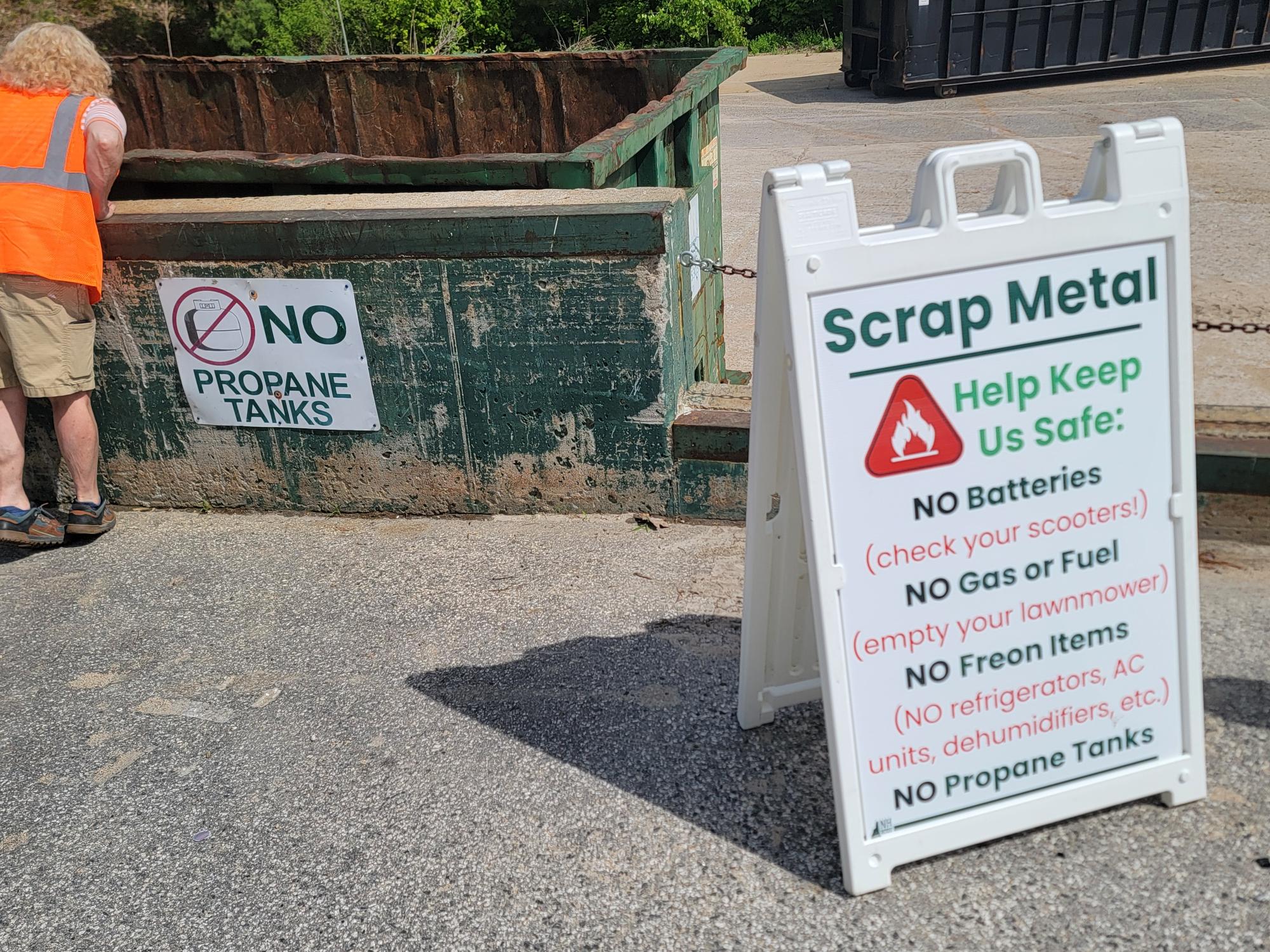
Andover does not have space for two stage separation, so the operators periodically check the scrap metal container for contamination, look over incoming loads, and have signage at the metal area. During the project, operators found the following items, that they removed from the scrap metal container:
- 2 rechargeable batteries.
- 1 item with gasoline.
If this material was not found and removed, it would have been a cost of $1,575 in fines from their scrap metal vendor, as well as possible ground contamination if the gas spilled or caused a fire either at the baler in Concord, NH, the shredder in Everett, MA, or onsite at the transfer station.
NH Recycles Recommendations:
- Two-stage separation
- Have operators inspect incoming and outgoing loads
- Post signage. Consider color blindness if you create your own signs.
- Since operators should be looking for contamination anyways, this is a great time to start a non-ferrous program to generate extra revenue. A simple program, if the town has room, can generate thousands of dollars in revenue to offset other disposal costs.


(Left) A scrap metal pile. (Right) A warning sign for residents to not put anything in the dumpster container.
HOUSEHOLD HAZARDOUS WASTE
One area of problems for the Town of Andover was that people were leaving items like oil and other chemicals at the facility without permission. The facility then had to store onsite and remove it. In July 2026, NH Recycles coordinated a vendor to come in and clean out their stored material. This was a cost of over $3,800 to the taxpayers of Andover. This included the following:
- 252 gallons of used motor oil.
- Approximately 60 gallons of other items.
This material looked like it was collected for numerous years before disposal.
NH Recycles added the dates of the Lakes Region Planning Commission (LRPC) annual HHW events to the mailer to give residents an easy way of identifying events, to properly dispose of material. LPRC provides 6 annual events for 22 participating towns, including Andover with a limit of 10 gallons or 50 pounds per household per event. They also provide links for residents about alternative events which people can pay for disposal, as well as educational and low toxic alternatives. At the time this is published, the 2026 data was not yet available. However, Andover residents only accounted for under 2% of participants from the 2024 and 2025 events. By distributing a postcard, NH Recycles hopes that more Andover residents participated in the 2026 events.
NH Recycles Recommendations:
- Have a printable brochure as well as a dedicated area on the town website for HHW event details and information for residents about disposal options of hazardous materials. Consider color blindness if creating your own.
- Add a QR code to a printed brochure that points to HHW events and disposal options. The QR could point to safety information on your town website, solid waste district, local planning commission, or the NH Recycles Solid Waste Safety Toolkit.(opens in a new tab)
- Inspect loads of incoming waste for hazardous materials, including black bags of construction and demolition debris.
- Aerosol containers, meaning anything with a propellant, can be handled as a universal waste. This includes spray paint, hairspray, sunscreen, bug spray, and cleaners. Contact NH Recycles for more information or review NHDES’ resources:
- Do you collect used oil on-site? Think about getting a used oil furnace to help save disposal costs as well as save on heating costs. NHDES offers grants for facilities that collect used oil(opens in a new tab) from residents who change their own oil. The funds may be used to establish, improve or operate a used oil collection center, as well as transport used oil off-site to a licensed recycler.