
Solid Waste Safety Summit Highlights Growing Lithium-Ion Battery Risks Across New Hampshire
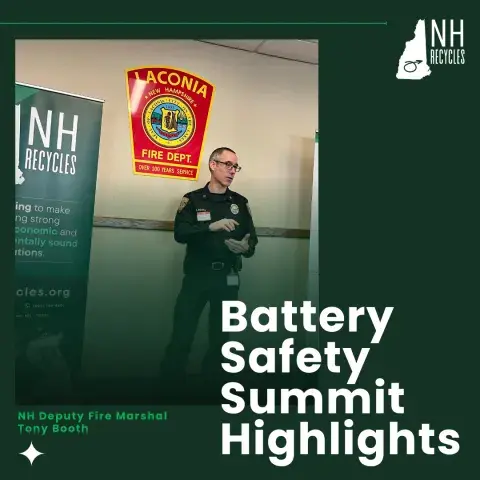
On February 12, municipal leaders, transfer station operators, firefighters, and state officials gathered at the Laconia Fire Department for NH Recycles’ first Solid Waste Safety Summit of 2026.
The focus? One of the fastest-growing safety risks in the waste stream: lithium-ion batteries.
Hosted in partnership with the Lakes Region Planning Commission, the NH Department of Environmental Services (NHDES), and the NH State Fire Marshal’s Office, the summit brought together those on the front lines of solid waste management to address an increasingly urgent issue—battery-related fires at transfer stations, recycling facilities, and even in homes.

Why Lithium-Ion Batteries?
As of July 1st, it is illegal for anyone in New Hampshire - resident, business, hauler, or transfer station (just to name a few) - to throw lithium-ion batteries into the waste stream to end up in a landfill or waste-to-energy incinerator.
The reason is simple: they are causing fires.

As Deputy State Fire Marshal Tony Booth explained during the summit:
A lithium-ion battery contains the fuel, ignition source, and oxidizer all in one package. Once compromised, it can ignite rapidly and burn intensely.
Real-World Examples from New Hampshire
Participants reviewed several recent New Hampshire incidents:
- Lee Transfer Station: Early detection prevented a major facility fire after staff spotted smoke and quickly isolated a burning lithium-ion battery.
- Pelham: A lithium-ion battery hidden in scrap metal ignited, requiring fire department and hazmat response.
- Keene: Multiple fires caused significant damage, including equipment loss and building impact. Lithium-ion batteries were determined to be at least contributing factors.
- Granite State Recycling Facility (Weare): A three-alarm fire resulted in a total building loss; cause unknown.
In several cases, fires caused hundreds of thousands of dollars in damage. In larger recycling facilities nationwide, losses have reached into the millions.
These incidents underscore a critical reality: one missed battery can have major consequences.

What Makes These Fires So Dangerous?
Lithium-ion batteries can enter “thermal runaway” if:
- Crushed or punctured
- Exposed to water
- Damaged by improper chargers
- Stored incorrectly
- Embedded in scrap metal or compacted waste
They can also burn underwater and may reignite even after appearing extinguished.
Unlike standard alkaline batteries (AA, AAA), lithium-ion batteries require careful handling and separation. Plus, lithium-ion batteries come in a variety of shapes and sizes (many look the same as alkaline batteries) - if it is rechargeable or if you have ANY doubts, it's always better to be safe than sorry.
Key Safety Takeaways for Transfer Stations
The summit focused on practical, on-the-ground solutions. Key recommendations included:
✔ Two-Stage Scrap Metal Separation
Operators should inspect scrap materials before they enter open-top containers to prevent hidden batteries from being crushed or shredded.
✔ Proper Battery Sorting & Storage
- Separate lithium-ion batteries from other battery types.
- Tape battery terminals or place in individual bags to prevent contact.
- Do not tightly seal storage containers—allow off-gassing to vent safely.
- Store in designated areas away from combustibles.
✔ Identify Embedded Batteries
E-bikes, scooters, power tools, toys, vapes, and even mop systems may contain non-removable batteries. When in doubt, treat the entire device as battery-containing equipment.
✔ Manage Damaged, Defective, or Recalled (DDR) Batteries Carefully
Swollen or punctured batteries require different handling and fall under hazardous waste requirements. For questions and assistance locating DDR kits, contact NH Recycles.(opens in a new tab)
✔ Partner with Local Fire Departments
Facilities are encouraged to invite fire departments onsite for walkthroughs so responders understand storage areas and site layouts before an emergency occurs.

What Residents Need to Know
Lithium-ion batteries should never go in the trash or scrap metal pile.
Rechargeable batteries should be brought to:
- Your local transfer station
- Approved battery collection programs
- Participating retailers
Standard alkaline batteries (AA/AAA) may still be disposed of in regular trash unless local policy differs—but rechargeable batteries must be separated.
The Bigger Picture
Beyond safety risks, battery fires impact:
- Municipal budgets
- Insurance rates
- Recycling facility operations
- Environmental protection
- Public health
Proposed legislation in New Hampshire is exploring extended producer responsibility (EPR) programs for batteries, which would shift recycling costs to manufacturers. Meanwhile, municipalities continue to manage the front-line impacts.

What’s Next?
This Laconia summit was the first of four Solid Waste Safety Summits planned for 2026. Additional in-person sessions and a statewide webinar are scheduled in the coming months to ensure access for communities across New Hampshire.
The goal is simple:
Protect people. Protect facilities. Protect communities.
NH Recycles is committed to helping municipalities navigate these evolving safety challenges with practical tools, education, and strong partnerships.
Want to Learn More?

Together, we can reduce risk—and keep New Hampshire’s recycling programs safe and sustainable.